

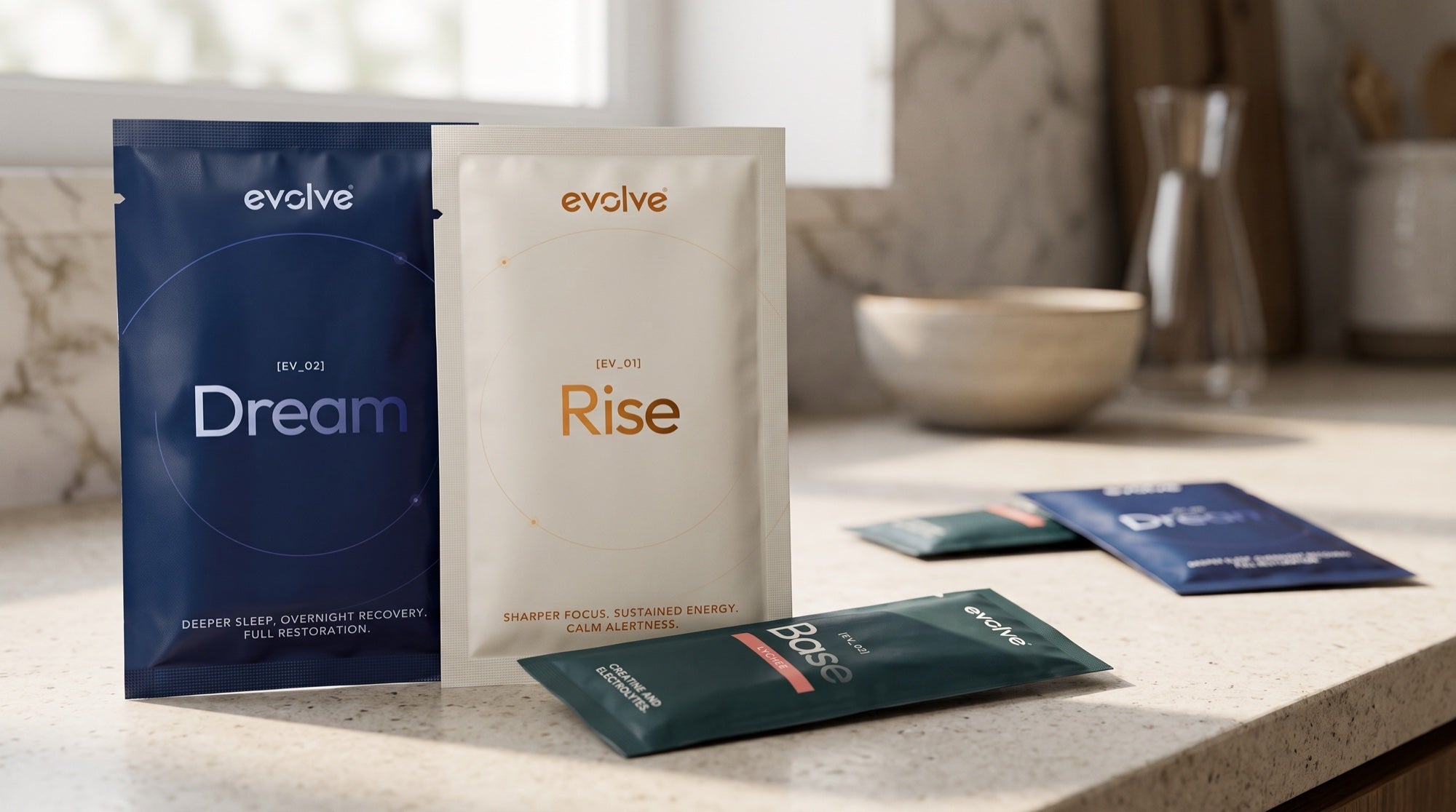
Your body is not the same machine at 7am and 11pm. Alertness, core temperature, and the hormones that drive output and repair all move on a roughly 24-hour cycle, so the support you take can move with them. This is the idea a circadian supplement protocol is built on: supplementation designed around time, not around a single ingredient. Performance support in the morning, recovery support at night, and a daily foundation underneath, running as one system. This guide covers what belongs in each phase, the exact amounts, and what the evidence does and does not show. One honesty up front: no trial has tested a complete three-formula protocol like this one. The design case is built ingredient by ingredient, and it is presented that way. Each phase links to a deeper article and to the formula that fills it.
Key takeaways
- A circadian supplement protocol is one system with three parts: a morning formula for performance, an evening formula for recovery, and a daily foundation of creatine and electrolytes.
- Timing is the organising principle, because alertness, core temperature and hormones follow a circadian rhythm. One all-day formula has to serve two opposite states at once, so it serves neither well.
- Morning: functional mushrooms, adaptogens and nootropics with every amount printed (for example Lion's Mane 600 mg extract, Rhodiola 300 mg).
- Evening: melatonin-free downregulation support (L-glycine 2150 mg, magnesium glycinate 1000 mg, L-theanine 200 mg).
- Foundation: creatine monohydrate 5 g daily, taken at any consistent time.
What a circadian supplement protocol is
Most supplements are sold one bottle at a time. One promises energy, another sleep, another hydration, each bought and judged alone. A circadian protocol treats them instead as parts of a single day. The unit is the system, not the bottle.
The organising principle is straightforward. Match the support to the state your body is already in. Your physiology is primed for output in the morning and for repair at night, so a formula built for focus belongs in the first and a formula built for downregulation belongs in the second. Creatine and electrolytes sit outside the clock entirely: creatine because it works by accumulation over weeks, electrolytes because they are a daily replacement need rather than a timed one. That is the whole of it: three phases, each doing different work, running as one system.
Why circadian timing matters
Your internal clock decides when you are wired to perform and when you are wired to wind down. Body temperature, alertness and hormone release all shift across roughly 24 hours. The research field of chrononutrition studies how the timing of what you take interacts with that clock.
The practical consequence is a mismatch problem. Ask one all-day formula to serve both the morning and the evening state and it has to pull in two directions at once. Split the job across the day and each half can be built for one state, with meaningful amounts for it. Circadian timing is not a detail added on top of a routine. It is the spine of the whole system. For the deeper case, see why the AM/PM split works.
The three phases at a glance
| Phase | Its job | evolve® formula | Go deeper |
|---|---|---|---|
| Morning | Focus, energy, stress resilience | Rise | below |
| Evening | Downregulation, sleep quality, recovery | Dream | melatonin-free sleep |
| Daily | Creatine and electrolyte foundation | Base | creatine timing |
Each day's output feeds that night's recovery, and recovery is what makes the next day's output possible. A protocol supports each turn of that cycle rather than a single moment in it.
The morning phase: performance
The morning side supports cognitive output, sustained energy and resilience to daily stress. The ingredient classes with the most relevant evidence are functional mushrooms, adaptogens and nootropics.
| Ingredient | Amount in Rise | Role |
|---|---|---|
| Lion's Mane extract | 600 mg | Supports cognitive function |
| Cordyceps extract | 600 mg | Supports energy production |
| Rhodiola Rosea | 300 mg | Supports stress resilience |
| Citicoline (CDP-choline) | 250 mg | Supports focus and mental clarity |
These ingredients are chosen for complementary mechanisms rather than reliance on any single one. Lion's Mane supports cognitive function, with human trials at gram-scale fruiting-body preparations reporting gains in processing speed; the extract amounts here are a stated formulation choice rather than a trial match. Rhodiola supports resilience to mental and physical stress, and several controlled trials report reduced mental fatigue under load. Evidence naturally varies between ingredients, but the point of the morning phase is not any one compound. It is a formula built around mechanisms that work together to support output through the day. Rise is that formula, four capsules, with every quantity printed on the label.
The evening phase: recovery
Night is not the absence of performance. It is the recovery state of the same operating system, when the body does the repair that makes the next day's output possible. The evening side supports that work: the fall in core temperature and nervous-system arousal that precedes good sleep. The aim is sleep quality and recovery, not sedation, which is why the night formula here is built melatonin-free and non-habit forming: a design choice to support the process rather than force the switch.
| Ingredient | Amount in Dream | Role |
|---|---|---|
| L-Glycine | 2150 mg | Supports natural downregulation |
| Magnesium Glycinate | 1000 mg compound | Supports muscle relaxation and nervous-system function |
| L-Theanine | 200 mg | Supports relaxation without drowsiness |
| Reishi extract | 600 mg | Supports natural wind-down |
The evening ingredients each carry specific human evidence, modest and their own. Glycine before bed supports the drop in core body temperature that helps sleep begin, a mechanism described in animal work, with small consistent trials behind it at 3 g. A 2025 randomised controlled trial of 250 mg elemental magnesium as bisglycinate found a small but significant improvement in insomnia scores over four weeks, and L-theanine at 200 mg supports relaxation without causing drowsiness. The combination has not been trialled together; each targets a different part of the same wind-down, which is the design logic of the formula, stated as design. Dream is the night formula, one sachet before bed. The full case for skipping melatonin has its own guide.
The daily foundation
Some support is not tied to a phase. Creatine works by saturation, so the hour you take it barely matters; electrolytes are a daily replacement need rather than a timed dose. What matters for both is that they are there every day.
Creatine monohydrate at 5 g per day is the clinically validated dose, and it supports muscle performance during high-intensity exercise. Its role reaches beyond the gym: a 2026 systematic review in Nutrition Reviews reported raised brain phosphocreatine over 12 weeks of daily 5 g use, with correlated gains on short-term memory measures. Creatine supports muscle and brain energy stores; the electrolytes alongside it support hydration, nerve signalling and muscle function. There is a sound physiological rationale for pairing them as a consistent daily foundation that works for cognitive and physical output alike. Base supplies the 5 g with a full electrolyte profile, and because timing is flexible it is the easiest habit in the protocol to keep.
How to build a protocol you will actually keep
Three principles separate a protocol from a shelf of bottles.
- Match the support to the phase. Performance in the morning, recovery at night, foundation every day. That single sentence is the whole of circadian timing.
- Use meaningful amounts, not trace inclusions. A long ingredient list at token amounts is a marketing decision, not a formulation one. Check a label's quantities against the doses the research actually used, and expect an honest account where they differ.
- Choose consistency over intensity. Most of this rewards daily consistency rather than one dramatic dose. The protocol that compounds is the one you still keep in three months. That is the real advantage of thinking in a system rather than in single products: the habit is what delivers, and the system is built to make the habit easy.
Frequently asked questions
What is a circadian supplement protocol? It is a way of organising supplementation around your body clock: a morning formula that supports performance, an evening formula that supports recovery, and a daily foundation of creatine and electrolytes. It treats day and night as connected phases of one 24-hour system rather than separate products.
What is the best time to take supplements? It depends on what each one supports. Focus, energy and stress-resilience support suits the morning. Relaxation and sleep-quality support suits the evening. Creatine and electrolytes can be taken at any consistent time. Matching the support to the phase is the core idea.
Can I just take one all-in-one supplement instead? You can, but a single daily formula has to serve both the morning and the evening state, and those states need opposite support. Splitting the protocol lets each half be built for one job, with meaningful amounts for it, rather than compromised across two.
Do I need melatonin for the evening phase? No. A night formula can support sleep quality without melatonin using ingredients such as glycine, magnesium glycinate and L-theanine that support the body's own downregulation, while staying non-habit forming.
How long until a circadian protocol works? The mushrooms, adaptogen and creatine build over weeks, so judge them on a month of consistency. The sleep-support ingredients act nearer the night itself, and glycine can support same-night sleep quality.
Last reviewed 1 September 2026. Written by Alex Lambert, co-founder of evolve®, where the formulas are built around circadian timing rather than single-dose convenience. This article is educational and is not medical advice.


