

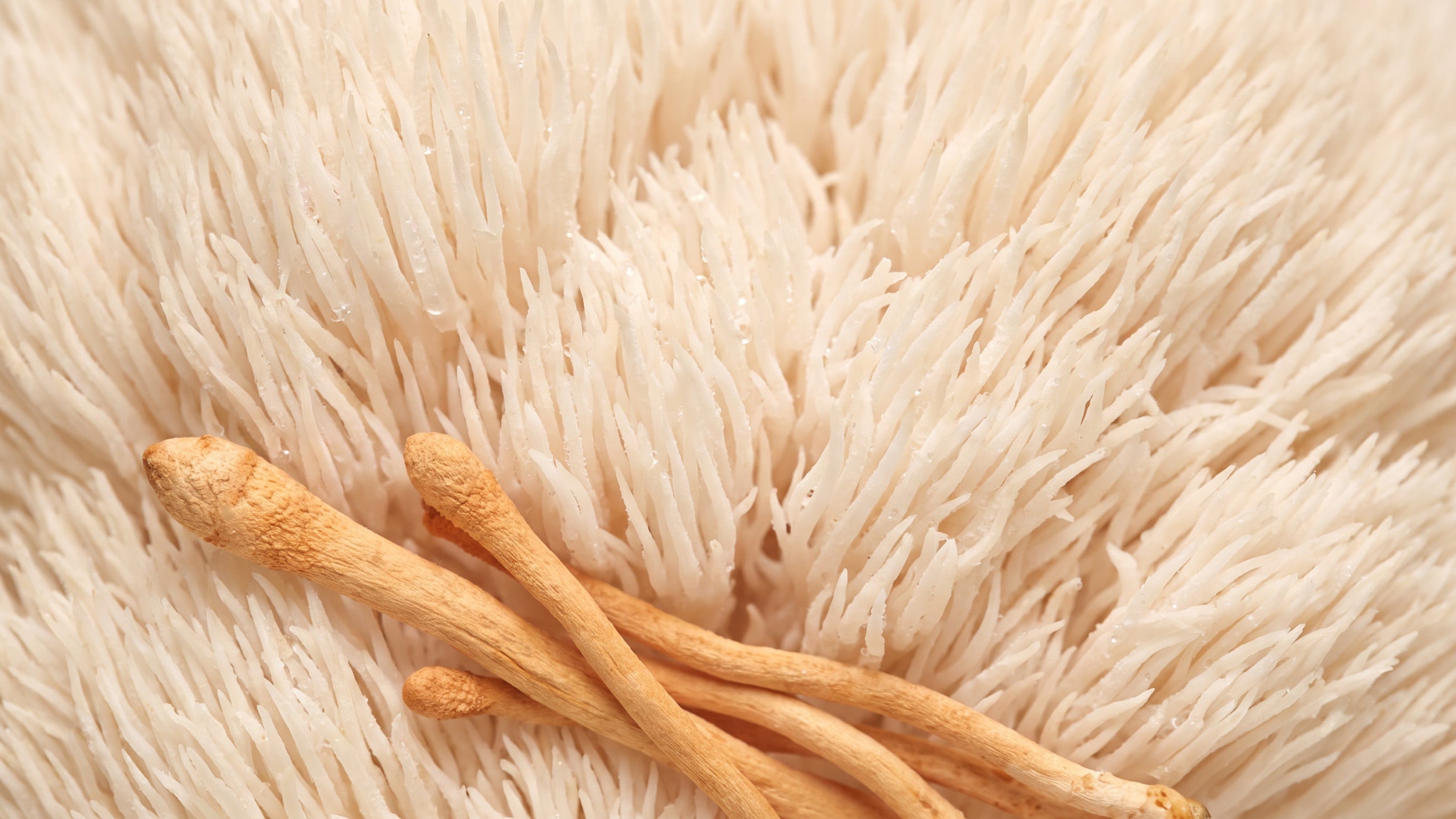
Yes, lion's mane and cordyceps can be taken together. They do complementary jobs: lion's mane is the cognitive half of the pair, studied in humans for processing speed, mood and cognitive function; cordyceps is the physical half, studied for aerobic capacity.
The human trials used about 3 g a day of dried lion's mane powder and roughly 1 g a day of a fermented cordyceps preparation, taken daily for weeks. Consistency, not clever timing, is what the results reward.
No trial has tested the two together. The pairing is a formulation judgement built on complementary mechanisms, not proven synergy, and this article grades each half on its own evidence.
Key takeaways
- Lion's mane's clearest human signal: a 16-week trial at 3 g a day of dried powder in older adults, with scores easing back after people stopped. Consistency is the mechanism.
- Cordyceps: a 12-week trial at about 1 g a day of the Cs-4 preparation raised the metabolic threshold roughly 10%, meaning more comfortable work at higher intensity.
- Neither mushroom carries an authorised EFSA health claim. In Rise, each sits at 600 mg of a standardised 40% polysaccharide extract, printed on the label.
Can you take lion's mane and cordyceps together?
Yes. No interaction between them has been documented at typical supplement amounts, and they are one of the most common pairings in morning formulas for a simple reason: they do complementary jobs. Lion's mane is studied for the brain. Cordyceps is studied for physical output and oxygen use. Putting them together covers two sides of a morning rather than doubling down on one.
That is why both live in the same morning formula instead of being two habits you have to keep apart. One formula, taken at a consistent time, is easier to hold than two, and consistency is where these ingredients earn their place.
How does lion's mane support the morning?
Lion's mane (Hericium erinaceus) is the cognitive half of the pair, included to support clear, steady thinking through the day.
The mechanism is well characterised. Compounds in lion's mane called hericenones and erinacines stimulate nerve growth factor in nerve cells, the signalling protein that helps neurons grow and maintain their connections. Most of that work sits in laboratory and animal models, and the human trials build on it.
The human signal is real. The most cited trial is a 2009 study in older Japanese adults with mild cognitive impairment: thirty people took 3 g a day of dried mushroom powder for 16 weeks, and cognitive scores climbed steadily during the trial. The telling detail is what happened next. Scores eased back four weeks after people stopped, which points to a benefit that depends on staying on it, the case for consistency written into the data.
Newer work adds to the picture, unevenly. A 2023 pilot study reported gains in speed of performance and lower subjective stress, a 2025 acute trial of 3 g of a concentrated extract in 18 healthy adults found no significant overall improvement on its composite cognition and mood measures, with an effect on one specific task, and a four-week study in menopausal women reported lower depression and anxiety scores. The through-line is a cognitive and mood role that rewards steady daily use, which is how lion's mane sits in the morning formula.
How does cordyceps support the morning?
Cordyceps is the physical half of the pair, included to support aerobic capacity and cellular energy over the day.
Mechanistically, cordyceps supports oxygen use and cellular energy production through compounds such as cordycepin and adenosine. As with lion's mane, much of that detail comes from laboratory and animal work, and the human trials are where it becomes practical.
The clearest human result comes from a 2010 trial that gave healthy older adults a fermented cordyceps preparation, Cs-4, at 333 mg three times a day, so about 1 g in total, for 12 weeks. Their metabolic threshold rose 10.5% and their ventilatory threshold 8.5% against placebo. In plain terms, that means working more comfortably at a higher intensity rather than lifting the absolute ceiling, since VO2 max itself held steady. A separate trial of a cordyceps-containing blend reported better tolerance to high-intensity exercise after three weeks. Together the human evidence points cordyceps squarely at aerobic capacity, the physical complement to lion's mane in a morning built for output.
One point worth getting right, because it is widely repeated wrong: the cordyceps dose in that landmark trial was around 1 g a day, not the 3 g often quoted. It was three capsules of 333 mg. We read the source, not the summary, and we state the real number.
Why lion's mane and cordyceps belong in the same morning formula
The two belong together because they cover complementary parts of a morning, cognition and physical output, and because both reward the same behaviour: showing up daily.
Each mushroom is included on its own mechanism and its own human evidence, the more useful way to build a formula. Rather than lean on a single compound, Rise pairs two that work on different systems, so the design does not depend on any one of them doing everything. That is a deliberate formulation choice, aimed at a productive morning rather than a story about synergy.
Neither mushroom carries an authorised EFSA health claim, so we describe how they work, cite the human trials, and print the doses on the label rather than promise a specific outcome. Transparency is the point, and the same principle runs through the whole evolve® system.
The evidence at a glance
| Role in the morning | What the human evidence supports |
|---|---|
| Lion's mane and cognition | A 16-week trial in older adults showed gains at 3 g a day of dried powder that eased back after stopping; healthy-adult studies add signals for processing speed. Reward for consistency. |
| Lion's mane and mood | A four-week study in menopausal women reported lower anxiety and depression scores. |
| Lion's mane and nerve growth factor | Well characterised in laboratory and animal models; the mechanism the human trials build on. |
| Cordyceps and aerobic capacity | A 12-week trial raised the metabolic threshold about 10% at roughly 1 g a day, meaning more comfortable work at higher intensity. |
| Why they pair | Complementary mechanisms across cognition and physical output; each is included on its own role, held steady daily. |
| EFSA health claim | None authorised for either mushroom, as botanical claims have been on hold since 2010, so we describe roles and cite trials. |
How much lion's mane and cordyceps are in Rise?
Trial amounts and product amounts are two different things, so here is both, side by side.
| Preparation | Amount used or included | Notes |
|---|---|---|
| Lion's mane, dried powder (Mori 2009) | 3 g a day | Whole dried mushroom, not a concentrated extract |
| Lion's mane, 10:1 extract (Surendran 2025) | 3 g, single dose | Concentrated extract, one acute dose |
| Cordyceps, Cs-4 preparation (Chen 2010) | About 1 g a day | Fermented mycelium, 3 × 333 mg |
| Lion's mane extract in Rise | 600 mg | 40% polysaccharide extract, a concentrated, standardised form |
| Cordyceps extract in Rise | 600 mg | 40% polysaccharide extract, a concentrated, standardised form |
A concentrated 40% polysaccharide extract is not the same as an equal weight of dried mushroom, so the numbers do not line up gram for gram, and we do not claim they do. No human trial has tested these exact extracts at these amounts, together or alone. What Rise offers is a standardised, transparent amount of each: 600 mg of a concentrated extract, printed on the label, taken as four capsules in the morning, chosen as a formulation decision and stated as one.
Both mushrooms belong to the daytime in the evolve® system. Lion's mane and cordyceps sit in Rise, taken at a consistent time, as the morning half of a full 24-hour circadian protocol. If you are building the habit from scratch, our guide to a morning supplement routine covers where they fit, and the AM and PM protocol shows how the morning formula pairs with the evening one.
Are they safe to take together?
For most healthy adults, both are well tolerated at typical supplement amounts, and no interaction between them has been documented.
The sensible cautions are specific rather than general. If you are pregnant or breastfeeding, on medication, or managing a health condition, check with your doctor first, and anyone with a mushroom allergy should avoid them. For a healthy person, both have a good tolerability record in the trials to date, which is why they sit comfortably in a formula built to be taken every morning.
Frequently asked questions
Can you take lion's mane and cordyceps together? Yes. No interaction has been documented at typical supplement amounts, and they support complementary systems, cognition and physical output. They are commonly combined for that reason. evolve® includes both in Rise, taken in the morning as four capsules.
Do lion's mane and cordyceps work better together? They are paired because they cover complementary parts of a morning, one for cognition and one for aerobic capacity, so the formula does not rely on any single compound. Each is included on its own mechanism and its own human evidence rather than on a claim that the two amplify one another.
How much lion's mane and cordyceps should I take? Human trials used about 3 g a day of dried lion's mane powder and roughly 1 g a day of a fermented cordyceps preparation. A concentrated extract is not comparable gram for gram with dried mushroom, and no trial has tested the extract amounts used in supplements. Rise includes 600 mg of a 40% polysaccharide extract of each, stated as a formulation choice.
When should I take lion's mane and cordyceps? In the morning, as part of a consistent daily habit. Both are studied for daytime functions, cognition and physical output, and both reward steady use over time rather than one-off doses.
Are there any EFSA health claims for lion's mane or cordyceps? No. EFSA has not authorised health claims for either mushroom, as botanical claims have been on hold since 2010. That is why we describe how they work and cite the human trials rather than promise outcomes.
The bottom line
Lion's mane and cordyceps belong together because they cover two sides of a morning: clear thinking and physical output. Lion's mane has human evidence for cognition and mood that rewards staying on it. Cordyceps has human evidence for aerobic capacity at around 1 g a day of a fermented preparation. Each earns its place on its own mechanism, the amounts are printed openly, and both are held steady over time. That is exactly how they sit in the evolve® system: in the morning formula, taken consistently, as the daytime half of a protocol built around when your body actually needs each thing.
Last reviewed 1 September 2026. Written by Teun Bart van Zoest, co-founder of evolve®, where lion's mane and cordyceps sit in the morning formula because they cover complementary parts of a productive day. This article is educational and is not medical advice.


