

A single daily formula asks one moment to do the work of a whole day, and physiology does not cooperate. Your body runs two opposing states in every 24 hours: an alert, output-oriented state after waking and a downregulated, recovering state at night. Ingredients that serve one state are wasted on the other, or work against it. Some support genuinely does hold all day, creatine and electrolytes being the clearest cases, but it is the smallest layer of the job. This article makes the case properly, including the part the one-bottle model gets right.
Key takeaways
- A single daily dose serves a single moment. Your body runs two opposing states each day: waking output and night-time downregulation.
- Ingredients take sides. Support for focus and energy metabolism belongs to the waking state; support for sleep quality and relaxation belongs to the evening one.
- A genuine all-day layer exists: creatine at 5 g, electrolytes, and daily vitamins work by saturation or steady supply, not by the hour.
- The answer is not more products. It is splitting support by state: morning, night, and a daily layer underneath.
The case for one bottle
The all-in-one model earned its popularity, and it is worth saying why before pulling it apart.
Consistency is the single biggest lever in supplementation. Almost everything worth taking works through repetition: creatine saturates stores over weeks, adaptogens build their effects with daily use, minerals top up a running balance. A formula you take every morning without thinking beats a shelf of bottles you remember twice a week. One dose, one habit, one decision. That is a real advantage, and any honest alternative has to preserve it.
The problem is what the single moment costs. Convenience solves the remembering problem and quietly creates a coverage problem, because it commits every ingredient to the same hour of a day that does not hold still.
Your day runs two opposite states
Within the first hour of waking, cortisol surges to its daily peak. Researchers call it the cortisol awakening response: circulating cortisol typically peaks 30 to 60 minutes after waking, priming the body for output. Alertness and cognitive performance then track a daily arc of their own. Studies of circadian rhythms in attention show performance rising through the day and falling at night, in phase with core body temperature.
The evening runs the same physiology in reverse. Core temperature falls, nervous-system arousal drops, and both changes precede sleep onset; the best-evidenced night-time ingredients, such as glycine, work by supporting exactly that temperature drop. The field of chrononutrition exists because what you take interacts with this clock, not with an average of it.
| Waking state | Evening state | |
|---|---|---|
| Cortisol | Peaks within the first hour | Falling towards its low |
| Alertness | Rising through the day | Winding down |
| Core temperature | Climbing | Dropping ahead of sleep |
| The job | Output | Recovery |
One formula, taken at one time, meets exactly one of these states. Whatever it contains for the other state arrives at the wrong end of the curve.
Ingredients take sides
This is not an abstract point. Run down any well-formulated label and almost every ingredient has a preferred state.
| Ingredient | Serves | Why |
|---|---|---|
| Lion's Mane, Cordyceps | Waking | Support cognitive function and energy production, work you do by day |
| Rhodiola Rosea | Waking | Supports mental performance under pressure |
| B vitamins | Waking | Support energy metabolism and reduction of tiredness and fatigue |
| Glycine | Evening | Supports the core temperature drop that precedes sleep |
| Magnesium glycinate | Evening | Supports muscle relaxation and sleep quality |
| L-Theanine | Either, by job | Calm focus by day, relaxation without drowsiness at night |
Put the left column in an evening dose and its purpose is spent before you use it. Put the right column in a morning dose and it pulls against the state you are trying to hold. A one-bottle formula must either leave one side out, which is a coverage gap dressed as simplicity, or include both and blunt each. The supplement-by-supplement verdicts are worked through in morning or night, for each supplement, and the pattern is hard to miss once you look for it: the timing question keeps resolving into the state question.
Sleep support makes the sharpest example. The ingredients with the best evening evidence, glycine, magnesium glycinate, L-theanine, do their work in the hours after you take them, which is the whole argument for a dedicated night formula rather than a token inclusion in a morning dose.
What genuinely works all day
Some support really does not care what time it is, and the argument only holds if that gets its full weight.
Creatine is the strongest case. At 5 g per day it works by saturating muscle and brain stores over weeks, so the hour is close to irrelevant and daily consistency is everything. A 2026 systematic review reported that daily 5 g supplementation raised brain phosphocreatine measurably over 12 weeks. Electrolytes support hydration and muscle function whenever you drink them. Daily vitamins at maintenance levels are about steady supply.
This is the layer the one-bottle model genuinely serves, and it deserves its own slot rather than dismissal. But notice its size: two or three jobs out of the whole label. The all-day layer is real, and it is the foundation, not the building.
A day split properly
Follow the logic to its end and you do not arrive at more supplements. You arrive at the same ingredients, sorted by the state they serve: waking support taken in the morning, downregulation support taken at night, and the saturation layer taken daily at whatever hour survives real life.
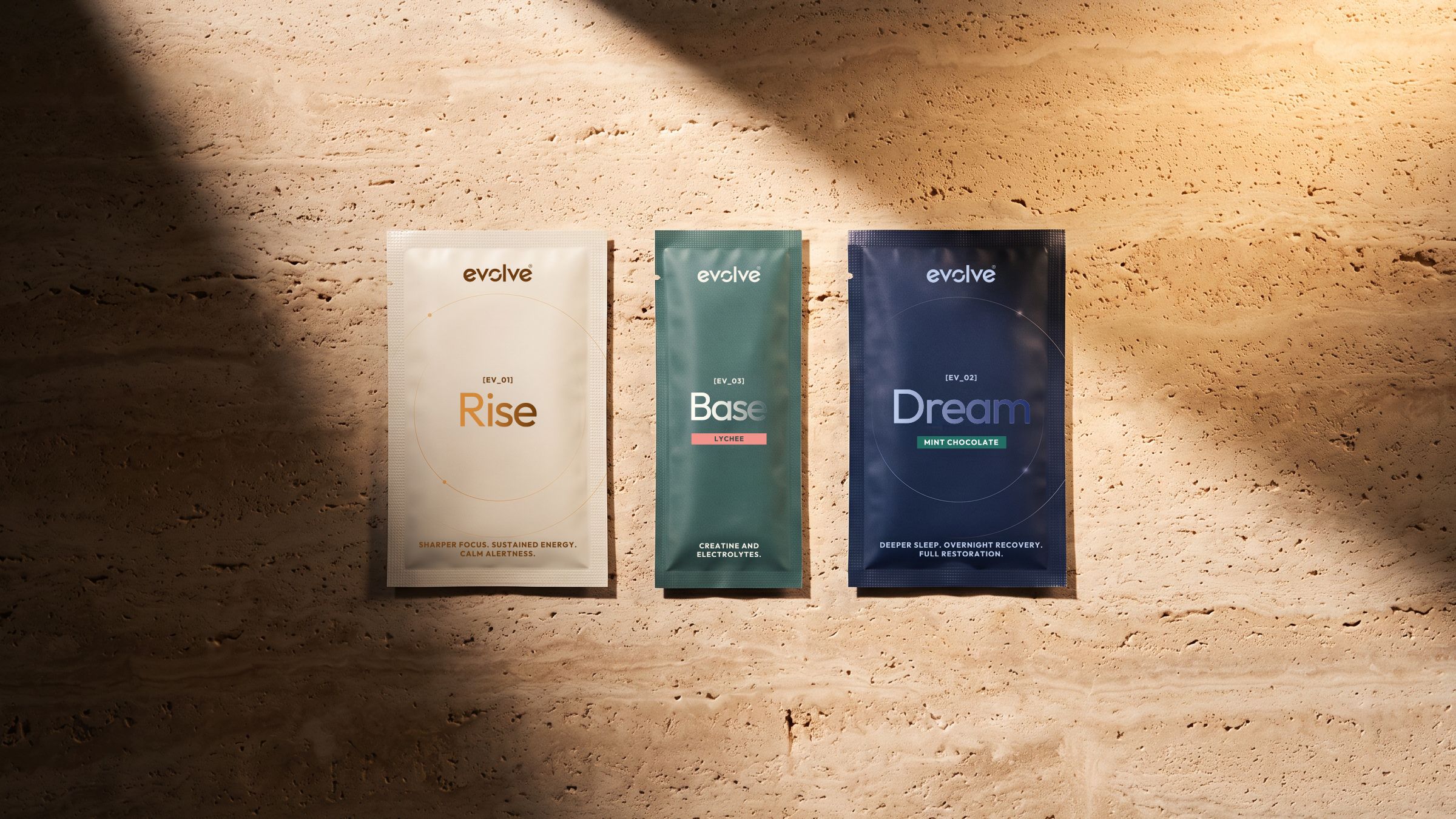
That three-way split is the shape of the evolve® system. Rise, taken in the morning, carries the waking side. Dream, taken at night, carries the evening side, melatonin-free and non-habit forming. Base carries the daily layer of creatine and electrolytes. The morning guide and the timing chart work each slot in detail, and the full reasoning, with doses and evidence for every phase, is in the circadian supplement protocol guide.
One habit was always the right goal. It just needed to be one habit with two moments in it.
Frequently asked questions
Are all-in-one supplements worth it? They solve a real problem, consistency, and for creatine, electrolytes, and daily vitamins the single-dose format works well. Where they fall short is state-dependent support: focus and energy ingredients and sleep-quality ingredients cannot both be served by the same hour.
Can one supplement cover both morning and night? Not well. Ingredients that support alertness and energy metabolism belong to the waking hours, while ingredients that support downregulation and sleep quality do their work in the hours after you take them. One dose time forces a compromise on at least one side.
Is it better to take supplements all at once or spread out? Sort by mechanism. Anything that works by saturation or steady supply, creatine being the clearest example, suits one consistent daily moment. Anything that serves a state, focus by day or wind-down at night, should be taken in that state's hours.
What is the simplest way to run a morning and night split? Two fixed slots anchored to things you already do: a morning dose with breakfast and an evening dose before bed, with the daily layer attached to whichever slot you never skip. The aim is a split you keep, not a schedule you manage.
Last reviewed 19 August 2026. Written by Alex Lambert, co-founder of evolve®, where the formulas are built around circadian timing rather than single-dose convenience. This article is educational and is not medical advice.


